April 8, 2026
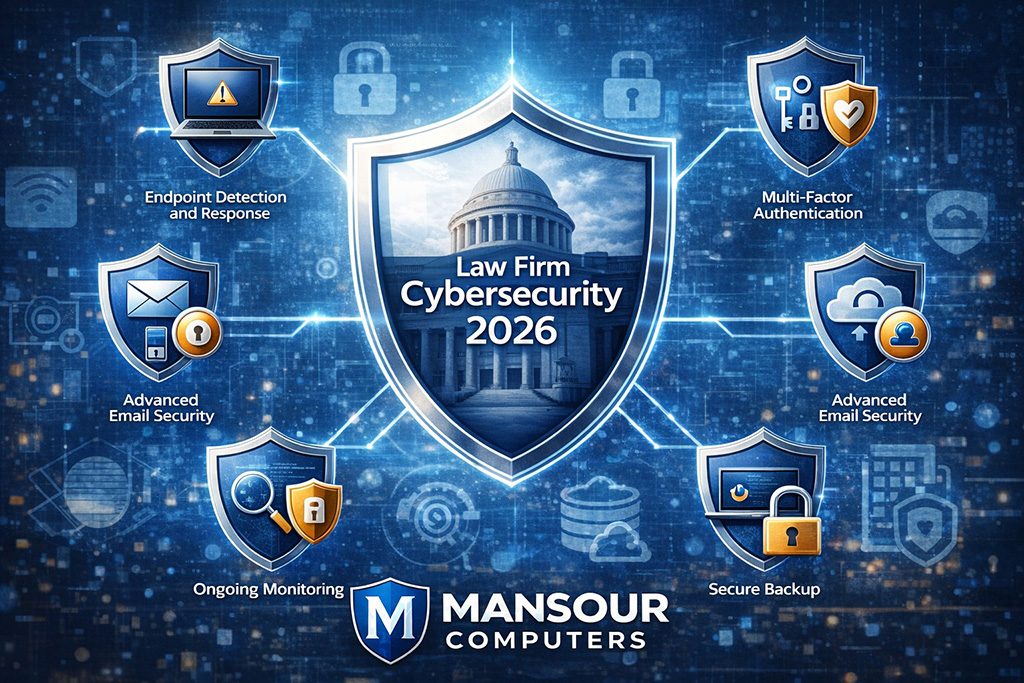
In 2026, a law firm should have core cybersecurity protections such as endpoint detection and response, multi-factor authentication, advanced email security, secure backups, encrypted devices, and ongoing monitoring. For firms with 10 to 50 employees, these protections are essential because legal practices handle highly sensitive client information, contracts, financial records, and confidential communications. Even a single breach, phishing event, or ransomware incident can interrupt operations and damage client trust.
Law firms across Central and Southeast Arkansas, including Little Rock, North Little Rock, Sherwood, and Pine Bluff, increasingly need stronger cybersecurity controls to protect privileged information and support secure daily operations.
Understanding which protections matter most helps law firms reduce risk and make smarter decisions about technology support.
The 6 Core Cybersecurity Protections Law Firms Should Have
1. Endpoint Detection and Response
Every workstation, laptop, and server used by the firm should be protected with endpoint security that can detect suspicious behavior and stop threats before they spread.
This is especially important when attorneys and staff access files from multiple locations.
2. Multi-Factor Authentication
Passwords alone are not enough.
Multi-factor authentication adds an extra layer of protection for:
- email accounts
- cloud storage
- remote access
- case management systems
- financial platforms
This helps prevent unauthorized access even if credentials are compromised.
3. Advanced Email Security
Email remains one of the most common attack paths for phishing and fraud.
A law firm should have email protections such as:
- phishing filtering
- malicious attachment scanning
- suspicious link protection
- impersonation detection
These controls help protect both the firm and its clients.
4. Secure Backup and Recovery
Law firms depend on access to documents, case files, communications, and records every day.
A strong backup strategy should include:
- daily backups
- secure offsite or cloud storage
- backup monitoring
- regular recovery testing
Backups are a key part of both business continuity and ransomware defense.
5. Device Encryption and Access Controls
Because legal work often involves mobile devices and remote access, encryption and access management are important.
This helps protect data if devices are lost, stolen, or accessed by the wrong person.
6. Ongoing Monitoring and Patching
Cybersecurity is not something a firm sets up once and forgets.
Law firms need ongoing:
- patch management
- account reviews
- system monitoring
- vulnerability reduction
- access oversight
These ongoing protections help reduce preventable risk over time.
Understanding What These Protections Cost
Many firms want to know how cybersecurity fits into their overall IT spending.
Our guide How Much Does IT Support Cost for a Law Firm in Arkansas? explains how support, security, and technology needs often come together in legal IT pricing:
How This Compares to General Managed IT Pricing
Some law firms also want a broader pricing comparison before making a decision.
Our guide How Much Does Managed IT Cost in Little Rock? explains the general pricing model for small business IT support and helps provide additional context:
Why the Right IT Provider Matters for Security
Even the right cybersecurity tools are less effective if the provider does not understand how to apply them in a legal environment.
Our guide How to Choose an IT Provider for a Law Firm in Arkansas explains what firms should look for when evaluating an IT partner’s security focus, responsiveness, and experience:
Real Example: Government Agency
A government agency in Central Arkansas partnered with Mansour’s Computer Solutions after experiencing an email security breach. Without an internal IT department, they needed a reliable partner to secure their systems and provide dependable support.
The Mansour team responded the same day, resolved the issue quickly, and implemented stronger cybersecurity protections moving forward.
Their leadership shared the following feedback:
“Since partnering with Mansour’s Computer Solutions out of Little Rock, Arkansas, our company has seen a significant boost in both security and peace of mind. When we experienced an email breach, their team responded the same day, resolved the issue promptly, and gave us the confidence to entrust them with all our IT needs.
We had never worked with an IT firm before, and now we can't imagine needing anyone else. The team is responsive, professional, and genuinely committed to helping us succeed.
As a small business without an in-house IT department, Mansour’s has become an essential extension of our operations—keeping our systems secure and running smoothly. If you're on the fence, don’t be. Choosing Mansour’s was one of the best decisions we've made.”
— Government Agency Client, Central Arkansas
About Mansour Computers
Mansour Computers provides cybersecurity-focused managed IT services for small and midsize businesses throughout Arkansas, with a primary focus on Central and Southeast Arkansas.
The company regularly supports organizations across:
- Little Rock
- North Little Rock
- Sherwood
- Pine Bluff
- and surrounding Arkansas communities
With over 20 years of experience, Mansour Computers helps organizations with 10–50 employees maintain secure and reliable technology environments through proactive monitoring, cybersecurity protection, and predictable fixed-fee IT support.
Businesses without an internal IT department rely on Mansour Computers as a trusted technology partner to keep their systems secure and operating efficiently.
Book a Quick 10-Min Discovery Call Today!
If you're evaluating IT support for your business or want to improve your cybersecurity protection, schedule a quick discovery call with our team to discuss your needs and answer any questions.